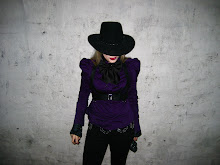
A Dutch outfit dripping in bloodlust, sex, and Satan, The Devil's Blood play 'Horror Soul' swollen with occult eroticism that brings the best of Black Sabbath, Roky Erickson, Blue Oyster Cult and the dueling guitars of Thin Lizzy together in ways you never imagined could be so deviant. Read a full review of their first full-length, The Time of No Time Evermore, over at The Big Takeover, and enjoy the full-on assault of their horn throwing head banging selves below as they ask the ever burning question, "Christ or Cocaine."
Thursday, July 29, 2010
Wednesday, June 16, 2010
Religious to Damn - Glass Prayer
Religious to Damn's first full-length opens with a whispered roar. Strains of acoustic guitar and cymbals introduce "To Love the Machine" in a deliberate slink as Zohra Atash's ethereal vocals melt into the mix. Here and throughout Glass Prayer, she manages a restrained power that's weightless without weakness, showcasing her lithe soprano in a tease that's never too forceful. The first track ends with a metallic echo, seamlessly transitioning into the next. What's evident even early into Glass Prayer is its wholeness. The deliberate continuation between songs, like a good old fashioned dance record, is not something you hear much on modern rock releases. The result is the feeling of a full album, not a string of singles as is often the default today.
While the sound Religious to Damn create has aural antecents in Cocteau Twins, Mazzy Star, Fleetwood Mac and their ilk, there's a more nuanced narrative playing out in the music. "Drifter" picks up with a driving, semi-psychedelic groove, and the chorus is layered with guitarist Josh Strawn's backup vocals to great effect; it's a less common pleasure to hear a woman on top in the mix with a supporting male voice beneath. On the title track, Atash keeps the fires burning with a punchy vocal melody as a striking bassline subtly prowls by, and "Black Sand" brings the spacious atmospherics with its slide guitar sprawl. Adding depth with her expressive contralto, Tamaryn's guest appearances on "Let the Fires Burn" and "The Bell" are also of note.
Stylistically, Glass Prayer offers up everything from acoustic folk and dreampop to hard rock, all channeled through washes of tempered passion. As the heaviest track on the record, "Terra" shows off Religious to Damn's versatility: Strawn's galloping vamp is reminiscent of a reoccurring theme on Pink Floyd's The Wall and the drums hit hard as Atash breathily repeats "a heart that bleeds does not deceive." The song unravels in epic fashion, ending with a forceful fade out.
Like many great records, a perceptive peeling back of the layers will reveal new and captivating details. Whether it be a percussive chime or a perfectly dissonant harmonium line, it's the hidden treasures that make Glass Prayer so memorable. Mesmeric pleasures abound with each and every listen.
Catch the band live at Lit this Sunday, and check out the entire record, now streaming on MySpace.
Wednesday, May 19, 2010
Metropolis 2010
Slate provides a slideshow covering the vast aesthetic influence of Fritz Lang's Metropolis, which is now on view with restored, never-before-seen footage at the Film Forum.
There are mentions of the obvious cinematic offspring - Star Wars, Blade Runner, The Fifth Element, and Madonna's "Express Yourself" - but really, just about everything in vogue right now references the dystopian, shadow-laced cityscape of Metropolis...


1. February 2010 Vogue Germany shoot by Karl Lagerfeld
2. 2010 Autumn/Winter line by Gareth Pugh
3. Late 2009 shoot of Lady Gaga by David LaChapelle
4. Late 2009 video of "Empire State of Mind" featuring Jay-Z + Alicia Keys
The list goes on...
There are mentions of the obvious cinematic offspring - Star Wars, Blade Runner, The Fifth Element, and Madonna's "Express Yourself" - but really, just about everything in vogue right now references the dystopian, shadow-laced cityscape of Metropolis...


1. February 2010 Vogue Germany shoot by Karl Lagerfeld
2. 2010 Autumn/Winter line by Gareth Pugh
3. Late 2009 shoot of Lady Gaga by David LaChapelle
4. Late 2009 video of "Empire State of Mind" featuring Jay-Z + Alicia Keys
The list goes on...
Tuesday, April 20, 2010
Light Asylum @ Knitting Factory
Above photo, second video: Jeff Elstone
Monday, April 19, 2010
Trans Am @ Knitting Factory + Thing
The new record is part muscular Man Machine, part montage music for an 80's action thriller. Live and on Thing, drummer Sebastian Thomson's voracious pummelling is the rock solid core of the band's sound. On "Black Matter" and "Arcadia" in particular, his heavy groove is situated seamlessly with the vocoded robot vocals that float atop the mix, swarming through hypnotic synths and unsettling guitar lines by Phil Manley and Nathan Means. Although it's been nearly 20 years since Trans Am started as an Oberlin college side project, they're still kicking out some killer (mostly) instrumental jams.
PH: Naomi Ramirez
Friday, April 16, 2010
Tactile Mind
Subverting the good 'ol strip club adage 'Look But Don't Touch' with her new book of handcrafted "pop-up" braille erotica, photographer Lisa J. Murphy's Tactile Mind is not only meant to be felt, but "felt up." Certainly a (sex) positive step towards including a population often passed over by the porn industry.
Wednesday, March 31, 2010
Lapham's Quarterly

Either an abomination or an aesthete's wet dream, Lapham's Quarterly is a literary journal like no other. Lewis H. Lapham, a former editor of Harper's, has created a publication that culls together lauded texts and images of the past filtered through a topical lens and contextualized with new contributions by the greats of today. It's the worst of channel surfing intellectualism or the best of post-modern ideological bricolage. Each issue presents a starting point for countless works of literature and schools of thought, constructing new contexts by situating disparate thinkers side by side. While the writers/artists tend to have a Eurocentric bent, the series has included many lesser known members of the global creative canon such as Japanese father of Noh drama Zeami, Persian lyric poet Hafiz, and Chinese literary critic Lu Ji.
Lapham's celebrates fragmentation and discontinuity while paradoxically presenting cohesive themes. The Spring 2010 issue, Arts & Letters, aims to examine how artists and their art have interacted with society throughout time. Amongst Nabokov, Van Gogh, James Baldwin, and a government report detailing the meeting between Elvis Presley and Richard Nixon, is a new essay by Salman Rushdie and a staged textual dialogue between Walter Benjamin and Andy Warhol. Between these excerpts are games, diagrams, and tables that present pertinent factoids like which mind-altering substances were used to create what great literary works (Uppers: Sarte's Critique of Dialectical Reason, Psychedelics: Huxley's Doors of Perception) or what songs were featured during which US presidential campaigns (Mondale: "Theme from Rocky," Dukakis: Neil Diamond's "America"). I'm still reeling from the mention of T-Pain, Matthew Barney, Hokusai, Harriet Beecher Stowe, and Ovid all in a single publication!
Like it or not, this byte size interdisciplinary approach to history and knowledge is fast becoming the future of thought. In both form and content, Lapham's Quarterly is a series tailor made for a post-internet world. It turns teleology on its head by offering a virtual reality on paper where turning a page is tantamount to jumping across milennia. Flip (click?) through a web of philosophical threads that are strung together Wikipedia-style until you're not quite sure where the original origin of your search lies. By all definitions, Lapham's is a dilettante's domain: how you choose to read it, however, is entirely up to you.
Subscribe to:
Posts (Atom)